

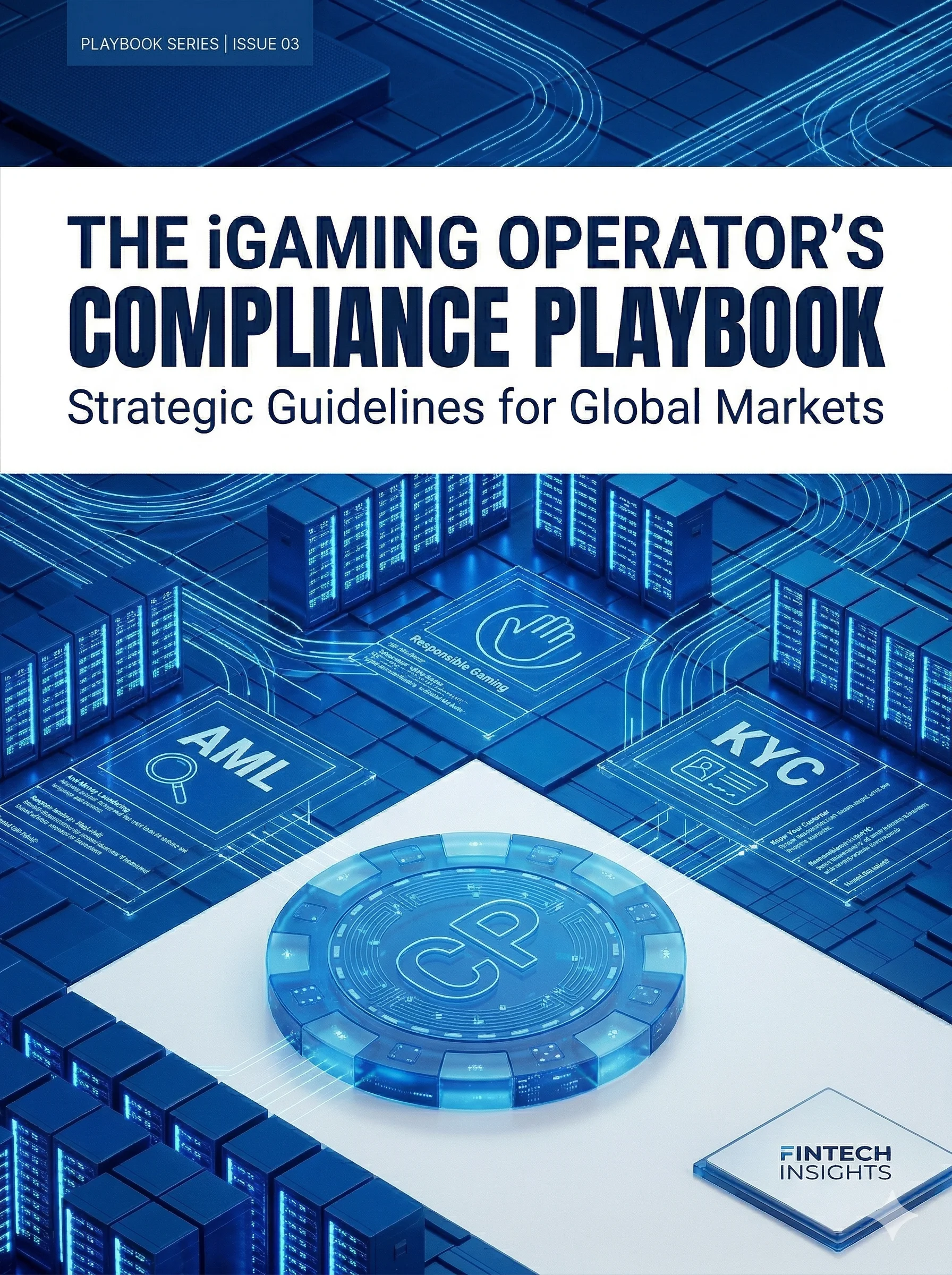
The iGaming Operator's Compliance Playbook: UKGC, MGA, and Curaçao
A multi-jurisdiction compliance guide for iGaming operators covering UKGC, MGA, and Curaçao licensing — KYC, AML, responsible gambling, and the failure to prevent fraud law.
Full name + work email required. We'll email you a copy.
The gambling compliance landscape is more fragmented — and more aggressively enforced — than at any point in the industry's history. The UK Gambling Commission (UKGC) now wields corporate criminal liability through the Economic Crime Act's "failure to prevent fraud" offense. The Malta Gaming Authority (MGA) polices one of the most mature online gambling markets in the world. Curaçao's modernized framework, launched in 2024, has moved that jurisdiction from permissive to genuinely regulated.
For operators serving players across multiple jurisdictions, the compliance question is not "which framework applies" — it is "how do I build one operational model that satisfies all three without tripling my compliance headcount."
This playbook provides the multi-jurisdiction framework: licensing comparison, KYC at every transaction touchpoint, AML obligations, responsible gambling integration, and a 90-day compliance action plan.
Licensing Comparison: UKGC vs MGA vs Curaçao
The three most common international iGaming licenses differ in cost, scope, enforcement posture, and market access. Operators must match their jurisdiction choice to their target player base, risk appetite, and operational capacity.
UK Gambling Commission (UKGC)
The UKGC license is the most rigorous — and the most valuable — regulatory credential in global iGaming. Operators must satisfy detailed Licence Conditions and Codes of Practice (LCCP), maintain UK-based compliance infrastructure, and demonstrate ongoing adherence through quarterly regulatory returns. The UKGC conducts regular audits and has revoked licenses from even large operators for failures in AML, safer gambling, or customer protection.
The UKGC license grants direct access to the UK market — the world's largest regulated online gambling market by gross gaming yield. It also carries the weight of the Economic Crime and Corporate Transparency Act 2023, which adds corporate criminal liability for failure to prevent fraud.
Malta Gaming Authority (MGA)
Malta's MGA license is the EU's most recognized iGaming credential. Operators licensed by the MGA can passport services across much of the European Economic Area (subject to each member state's national rules). The MGA framework is sophisticated — it distinguishes between B2C licenses (operator-to-player) and B2B licenses (for software providers and platform services) — and enforcement is active.
The MGA places strong emphasis on player protection, responsible gambling, and the integrity of gaming operations. The license is widely respected by payment processors, banks, and media partners — a factor that materially affects operator economics.
Curaçao
Curaçao's new 2024 licensing framework replaced the legacy "sub-license" model that had made the jurisdiction notorious for light oversight. Under the current framework, operators license directly with the Curaçao Gaming Control Board (GCB), comply with enhanced KYC and AML requirements, and submit to ongoing supervision.
Curaçao remains the most accessible international license — faster approval, lower capital requirements, broader acceptable payment methods — but the compliance obligations are no longer nominal. Operators treating Curaçao as a minimum-viable license should understand that enforcement has tightened and will continue to tighten.
| Dimension | UKGC | MGA | Curaçao |
|---|---|---|---|
| Market access | UK only (direct) | EU via passporting | Global (accepted in most markets) |
| Typical approval time | 12–18 months | 6–12 months | 3–6 months |
| Capital requirements | Substantial (variable) | Moderate (€100K+) | Lower (variable) |
| Criminal liability | Yes (ECCTA 2023) | No | No |
| Regulatory posture | Most rigorous | Rigorous and mature | Tightening |
KYC at Every Transaction Touchpoint
The common mistake in iGaming compliance is treating KYC as a one-time event at registration. In practice, effective operators verify (or re-verify) identity at three distinct touchpoints: registration, play, and withdrawal.
At Registration
Document capture, biometric matching, liveness detection, and age verification before any deposit. Operators should require full KYC at registration (not the deprecated "verify later" model where account creation is separated from identity verification). Age verification must be biometric or document-based — self-declaration does not satisfy UKGC or MGA standards.
Biometric deduplication at registration catches multi-accounting before a bonus is paid. This is the single highest-ROI control an operator can implement: bonus abuse costs 10–15% of promotional spend, and biometric dedup eliminates the most common vectors.
During Play
Session-level verification triggers when a player's activity deviates from their verified profile: sudden changes in deposit size, play duration, or game selection. Behavioral monitoring should produce risk signals that route to compliance for review, not automatic account restrictions (which create friction for legitimate high-rollers).
Responsible gambling checks integrate here: the LCCP requires operators to identify players showing signs of harm and intervene proportionately. Integration of identity, behavioral, and affordability signals produces the composite risk picture the UKGC expects.
At Withdrawal
Before the first withdrawal, operators must have completed full Source of Funds (SoF) verification for any account exceeding the threshold set by jurisdiction (typically £2,000 aggregate under UKGC; thresholds vary elsewhere). Withdrawals are the highest-risk transaction type from an AML perspective — they are where laundered funds leave the operator's custody.
Withdrawal-gated KYC prevents the "play-then-demand" pattern where fraudulent accounts deposit, win, and attempt to cash out to newly verified payment methods. Full verification before withdrawal closes this gap.
AML Obligations
Gambling is a designated "covered person" or "accountable institution" category in most regulated jurisdictions. Operators must implement the full AML program: customer due diligence at onboarding, ongoing transaction monitoring, suspicious activity reporting, sanctions screening, PEP screening, and record retention.
Under UK law, operators must file Suspicious Activity Reports (SARs) with the National Crime Agency for any transaction or pattern suggesting money laundering. Under Maltese law, reports flow to the Financial Intelligence Analysis Unit (FIAU). In all cases, the SAR filing standard is "knowledge or suspicion" — a deliberately low bar that creates significant filing volume at scale.
Pull quote“The UKGC has revoked licenses for AML failures. It has also fined operators for insufficient SAR filings. The regulator expects volume — operators that file too few SARs are signaling inadequate monitoring.”
iGaming-Specific AML Red Flags
- Rapid sequence of small deposits followed by minimal play and full withdrawal (placement + layering)
- Play patterns inconsistent with the player's verified profile (professional-level play from a self-declared recreational player)
- Use of multiple payment methods across a short period without clear justification
- Deposits routed through unusual intermediaries or jurisdictions
- Behavioral indicators of account sharing or player farming (changes in playing style, timezone, or device)
- Structuring: repeated deposits just below reporting thresholds
Responsible Gambling Integration
Responsible gambling is not a separate workflow — it is an identity-linked capability. GAMSTOP (UK) and its equivalents elsewhere require operators to check every new registration against a self-exclusion register and to maintain that check for the duration of the self-exclusion period. Operators that fail to enforce self-exclusion face UKGC fines.
The identity verification system must integrate with self-exclusion registries, affordability checks, and problem-gambling indicators. When a player self-excludes, the system must not only close the active account but also prevent re-registration under any name variation the same person might try. This requires biometric matching against self-excluded individuals — not just name-and-date-of-birth matching, which fails against common identity variations.
The UK "Failure to Prevent Fraud" Offense
Section 199 of the Economic Crime and Corporate Transparency Act 2023 creates corporate criminal liability for large organizations that fail to prevent fraud committed by associated persons. Most UKGC-licensed operators of meaningful scale qualify as "large organizations" under the Act.
The only defense is demonstrating "reasonable procedures" were in place. Identity verification that catches synthetic identities, prevents multi-accounting, detects deepfake-assisted fraud, and maintains continuous monitoring — with audit logs documenting system operation — is the evidentiary foundation of that defense.
The 90-Day Compliance Action Plan
- Map every jurisdiction you operate in and the specific license conditions that apply
- Inventory current KYC coverage — what percentage of active accounts have completed full verification
- Document current AML monitoring rules and SAR filing volume (vs peer benchmarks)
- Identify multi-accounting and bonus abuse losses over the last 12 months
- Review self-exclusion enforcement — test for re-registration gaps
- Close KYC completion gaps — require full verification for any active account
- Deploy biometric deduplication against the entire existing user base
- Upgrade deepfake detection if current liveness checks are the only biometric control
- Integrate self-exclusion registry checks into the registration flow (all jurisdictions)
- Tune AML transaction monitoring to capture iGaming-specific red flags
- Produce the "reasonable procedures" evidence pack for ECCTA defense (UK operators)
- Establish monthly compliance KPIs — SARs filed, accounts blocked at dedup, verification completion rate
- Train customer-facing and finance teams on jurisdiction-specific red flags
- Schedule annual penetration testing of the verification and monitoring stack
- Prepare regulator-ready documentation: flows, policies, audit logs, exceptions
iGaming Operator Compliance FAQ
- Which iGaming license offers the best global market access?
- None offers true global access. MGA passports across much of the EEA. UKGC grants UK market access. Curaçao is widely accepted internationally but does not include EU or UK access. Operators targeting multiple regions typically hold multiple licenses.
- Do I need biometric verification under MGA and Curaçao rules?
- Biometric verification is not explicitly required by MGA or Curaçao but is strongly recommended. It is the only reliable defense against multi-accounting and is increasingly expected as part of "reasonable procedures." UKGC enforcement precedent treats the absence of biometric dedup as a control gap.
- What triggers a SAR filing in an iGaming context?
- Knowledge or suspicion of money laundering or terrorist financing. Common triggers include unusual deposit-withdrawal patterns, play inconsistent with the player's profile, use of multiple payment methods without justification, and structuring just below reporting thresholds.
- How does the UK "failure to prevent fraud" offense affect non-UK operators?
- It applies to any large organization with UK operations — including operators headquartered abroad but serving UK players under a UKGC license. The offense is corporate criminal liability, not regulatory, and cannot be discharged by fines alone.
- What is the minimum AML monitoring volume a UKGC operator should expect to file?
- There is no fixed ratio, but the UKGC has publicly criticized operators whose SAR filings fall below peer benchmarks for their size and customer volume. A meaningful operator typically files dozens to low hundreds of SARs per quarter — operators filing near zero attract regulatory scrutiny.
Relevant Articles

How UK Gambling Operators Must Respond to the 'Failure to Prevent Fraud' Law
The UK's corporate criminal liability framework.
Apr 29, 2026

How Online Casinos Are Using AI to Stop Bonus Abuse and Multi-Accounting
Detection techniques for iGaming operators.
Apr 18, 2026

KYC for iGaming in Latin America
The LATAM regulatory landscape.
Apr 26, 2026

Gambling Compliance in the Philippines
APAC regulatory transformation.
May 7, 2026
What is deepidv?
Not everyone loves compliance — but we do. deepidv is the AI-native verification engine and agentic compliance suite built from scratch. No third-party APIs, no legacy stack. We verify users across 211+ countries in under 150 milliseconds, catch deepfakes that liveness checks miss, and let honest users through while keeping bad actors out.
Learn More