

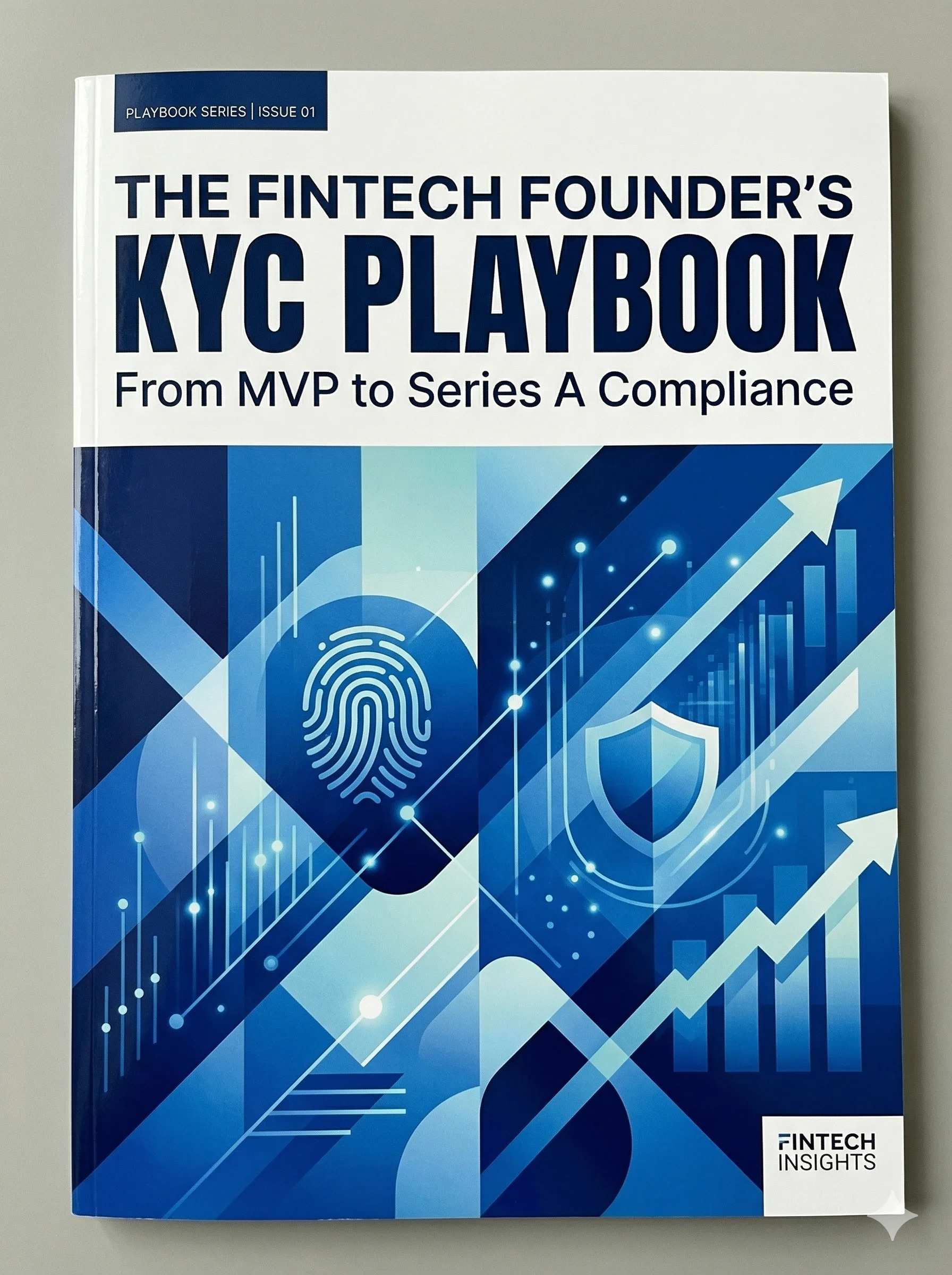
The FinTech Founder's KYC Playbook: From MVP to Series A Compliance
A step-by-step guide for FinTech founders building KYC compliance from first prototype to Series A — covering what to build, what to buy, and what to skip.
Full name + work email required. We'll email you a copy.
You have a working prototype. Your first users are onboarding. An investor asks: "What's your compliance story?" And you realize that the answer — "we check email addresses" — is not going to survive due diligence.
This is the moment every fintech founder hits. You built the product first (correct) and now you need to add identity verification before the regulatory conversation kills your fundraise. The problem is that the verification landscape is confusing, the vendor pitches are identical, and the cost structures are opaque.
This playbook cuts through the noise. It maps the exact KYC decisions you need to make at each stage — from pre-launch to Series A — with specific guidance on what to build in-house, what to buy from a vendor, and what to defer until you have more data.
Stage 1: Pre-Launch (0 Users)
What You Actually Need
Before your first user touches your product, you need three things and only three things: a decision about which jurisdictions you will serve (this determines your regulatory obligations), a documented compliance policy (even a two-page document counts — it shows intent), and a vendor relationship or integration plan for identity verification.
You do not need a full AML program. You do not need a compliance officer. You do not need transaction monitoring. Those come later. Right now, you need the foundation.
The Jurisdiction Decision
Your regulatory obligations are determined by where your users are, not where you are incorporated. A Delaware C-Corp serving users in the EU must comply with EU AML directives. A UK fintech serving US users must comply with FinCEN requirements. Map your target markets and identify the regulatory bodies in each.
For most early-stage fintechs, the practical starting point is one primary market. If you are US-focused, your regulatory obligations flow from FinCEN and state-level regulators. If you are EU-focused, AMLD5/AMLD6 and the upcoming AMLR. If you are UK-focused, the FCA and the Money Laundering Regulations 2017.
Do not try to be compliant everywhere on day one. Pick your beachhead market, nail compliance there, and expand jurisdiction by jurisdiction as you scale.
The Compliance Policy
Write a two-page document that covers who your customers are (individuals, businesses, or both), what identity verification you will perform at onboarding, how you will screen customers against sanctions lists, and when you will file suspicious activity reports.
This document is not a legal filing. It is your operating framework. Investors want to see that you have thought through compliance — not that you have hired a 20-person compliance team. The document demonstrates intent, which is what matters at this stage.
Stage 2: MVP Launch (1–1,000 Users)
The Build vs Buy Decision
Pull quote“Every hour your engineering team spends building verification infrastructure is an hour they're not building your product. At the MVP stage, that trade-off is fatal.”
— Shawn-Marc Melo, CEO deepidv
This is where most founders make their most expensive mistake: they try to build identity verification in-house. The reasoning seems sound — "we're engineers, we can build anything, and we'll save money." The reasoning is wrong.
Building identity verification from scratch requires document template libraries for every country you serve (211+ countries, thousands of document types), biometric matching models trained on diverse populations, liveness detection that passes iBeta Level 2 PAD testing, deepfake detection that catches injection attacks, sanctions screening against OFAC, EU, UN, and country-specific lists, and ongoing model retraining as documents change and attack vectors evolve.
Even a basic implementation — US documents only, no deepfake detection, no sanctions screening — takes 3–6 months of engineering time and produces a system that is less accurate than any commercial provider.
Buy. Every time. At this stage, your engineers should be building the product that differentiates your company, not commodity infrastructure that a vendor does better.
What to Look For in a Vendor
Not all verification vendors are created equal. The differences that matter at the MVP stage are coverage (how many countries and document types does the vendor support — you may not need 211 countries today, but you will need them when you expand), speed (sub-second verification keeps onboarding friction low — anything over 5 seconds and you lose users), accuracy (false rejection rates matter as much as false acceptance rates — a system that rejects real users kills growth), integration complexity (SDK, API, or white-label? How many engineering hours does integration take?), and pricing structure (per-check pricing, monthly minimums, volume discounts — model the cost at 10x your current volume to avoid pricing surprises).
The Minimum Viable Compliance Stack
At the MVP stage with under 1,000 users, your compliance stack needs four components:
Identity verification — Document capture + biometric matching + liveness detection. This is the core check that confirms your user is a real person with a real identity document.
Sanctions screening — Real-time check against OFAC SDN list, EU sanctions, UN sanctions, and any country-specific lists relevant to your jurisdiction.
PEP screening — Politically Exposed Persons screening identifies users who hold (or have held) prominent public positions and may present elevated money laundering risk.
Record keeping — Store verification results, screening outcomes, and decision rationale for a minimum of 5 years (requirement in most jurisdictions).
You do not need transaction monitoring at this volume. You do not need enhanced due diligence automation. You do not need a case management system. Add those when your user base and transaction volume justify them.
Stage 3: Growth (1,000–50,000 Users)
When Transaction Monitoring Becomes Mandatory
As your user base grows, transaction monitoring transitions from optional to mandatory. The threshold varies by jurisdiction, but as a practical matter, once you are processing more than a few hundred transactions daily, you need automated monitoring.
Transaction monitoring evaluates every transaction against risk rules and behavioral baselines: is this transaction unusually large for this user? Is this pattern consistent with structuring (breaking large amounts into smaller transactions to avoid reporting thresholds)? Is this user transacting with counterparties in high-risk jurisdictions?
At this stage, your monitoring can be rule-based — a set of defined thresholds and patterns that trigger alerts. Machine learning-based monitoring comes later when you have enough data to train models on your specific user population.
Enhanced Due Diligence Automation
Not every user presents the same risk. Enhanced Due Diligence (EDD) applies additional scrutiny to higher-risk users: PEPs, users from higher-risk jurisdictions, users with unusual transaction patterns, and users whose source of funds cannot be easily explained.
At the growth stage, you need a system that automatically flags users for EDD based on risk criteria, routes EDD cases to your compliance team for review, documents the EDD decision and rationale, and schedules periodic re-review of EDD cases.
Pull quote“The compliance infrastructure you build at 10,000 users is the infrastructure investors evaluate at Series A. Build it right the first time.”
The Compliance Hire
Somewhere between 5,000 and 20,000 users, you need your first dedicated compliance person. This does not need to be a Chief Compliance Officer with 20 years of experience. It needs to be someone who understands your regulatory obligations, can review alerts and make SAR filing decisions, can represent your compliance program to regulators, and can translate regulatory requirements into product specifications for your engineering team.
If you cannot hire a full-time compliance person, engage a compliance consultant on a retained basis. What you cannot do is leave compliance decisions to engineers who are not trained to make them.
Stage 4: Series A Readiness (50,000+ Users)
What Investors Actually Evaluate
By the time you are raising a Series A, your compliance program needs to withstand investor due diligence. Investors (and their legal teams) evaluate six areas.
Licensing. Are you properly licensed or registered in every jurisdiction where you operate? Do you have pending applications where required?
KYC completeness. What percentage of your user base has completed full identity verification? The answer needs to be 100% for your active user base. A gap — "we verified 85% of users" — is a red flag.
AML program. Do you have documented policies, transaction monitoring, sanctions screening, SAR filing procedures, and record keeping? Can you demonstrate that the program is followed in practice, not just on paper?
Verification vendor. Who provides your identity verification? What is the contractual relationship? What happens if the vendor raises prices or changes terms? Investors prefer vendors with no third-party dependencies — because those dependencies create cascading vendor risk.
Compliance team. Who is responsible for compliance? What is their background? Is the function adequately resourced for your current scale and projected growth?
Regulatory history. Have you received any regulatory inquiries, enforcement actions, or fines? Have you filed SARs? (Having filed SARs is actually a positive signal — it shows your monitoring is working.)
The Cost Model Investors Want to See
Investors will ask about your cost-per-verification and how it scales. The answer they want to hear is that your verification costs decrease as a percentage of revenue as you grow — not that they increase proportionally.
This is where vendor architecture matters. Verification providers built on stacked third-party APIs pass through the cost of every downstream API — document classification from one provider, biometric matching from another, sanctions screening from a third. Each takes a margin. Your cost is the sum of all margins plus the vendor's margin on top.
Providers that own their technology stack — document intelligence, biometric matching, deepfake detection, risk scoring, sanctions screening all built in-house — can offer structurally lower pricing because there are no third-party markups.
At Series A scale, the difference between a $5 per-check stacked provider and a $1–2 per-check in-house-stack provider compounds into hundreds of thousands of dollars annually.
The FinTech KYC Checklist
- Identify target jurisdictions and regulatory bodies
- Write a 2-page compliance policy (customer types, verification procedures, screening, reporting)
- Select and integrate an identity verification vendor
- Implement sanctions and PEP screening
- Verify 100% of users at onboarding (document + biometric + liveness)
- Store verification results and decision rationale (5-year minimum)
- Establish a SAR filing procedure (even if you have not filed one yet)
- Document your compliance program for investor conversations
- Implement automated transaction monitoring (rule-based)
- Build Enhanced Due Diligence workflows for higher-risk users
- Hire or retain a dedicated compliance resource
- Conduct your first internal compliance audit
- Achieve 100% KYC completion across active user base
- Document and demonstrate a functioning AML program
- Model verification cost-per-check at 10x current scale
- Prepare compliance section of investor data room
- Ensure verification vendor has no single-point-of-failure dependencies
FinTech KYC Playbook FAQ
- When should a fintech founder start thinking about KYC?
- Before your first user. The jurisdiction decision, compliance policy, and vendor selection should happen during product development — not after launch.
- Should early-stage fintechs build or buy identity verification?
- Buy. Building verification in-house requires document libraries, biometric models, deepfake detection, and sanctions screening that take 3–6 months of engineering time and produce inferior results compared to commercial providers.
- What is the minimum KYC stack for a fintech MVP?
- Four components: identity verification (document + biometric + liveness), sanctions screening, PEP screening, and record keeping. Transaction monitoring and enhanced due diligence come at the growth stage.
- When do fintechs need a dedicated compliance hire?
- Between 5,000 and 20,000 users. Before that, a retained compliance consultant can cover the function. After that, the volume of alerts, regulatory interactions, and SAR filings requires a dedicated resource.
- What do Series A investors evaluate in a fintech's compliance program?
- Licensing status, KYC completion rates (must be 100%), AML program documentation, verification vendor architecture, compliance team adequacy, and regulatory history.
Relevant Articles

What Is KYB — And Why It Matters for Platform Businesses
Business verification for fintech platforms.
Apr 30, 2026

How Tariffs Are Reshaping FinTech Compliance
Economic pressures on verification costs.
Apr 10, 2026

The 5 Deepfake Tools Fraudsters Actually Use
What your verification must detect.
Apr 14, 2026

MiCA Compliance Checklist: Before July 2026
EU compliance framework for crypto fintechs.
Apr 23, 2026
What is deepidv?
Not everyone loves compliance — but we do. deepidv is the AI-native verification engine and agentic compliance suite built from scratch. No third-party APIs, no legacy stack. We verify users across 211+ countries in under 150 milliseconds, catch deepfakes that liveness checks miss, and let honest users through while keeping bad actors out.
Learn More